Brandenburg v. Ohio (1969)
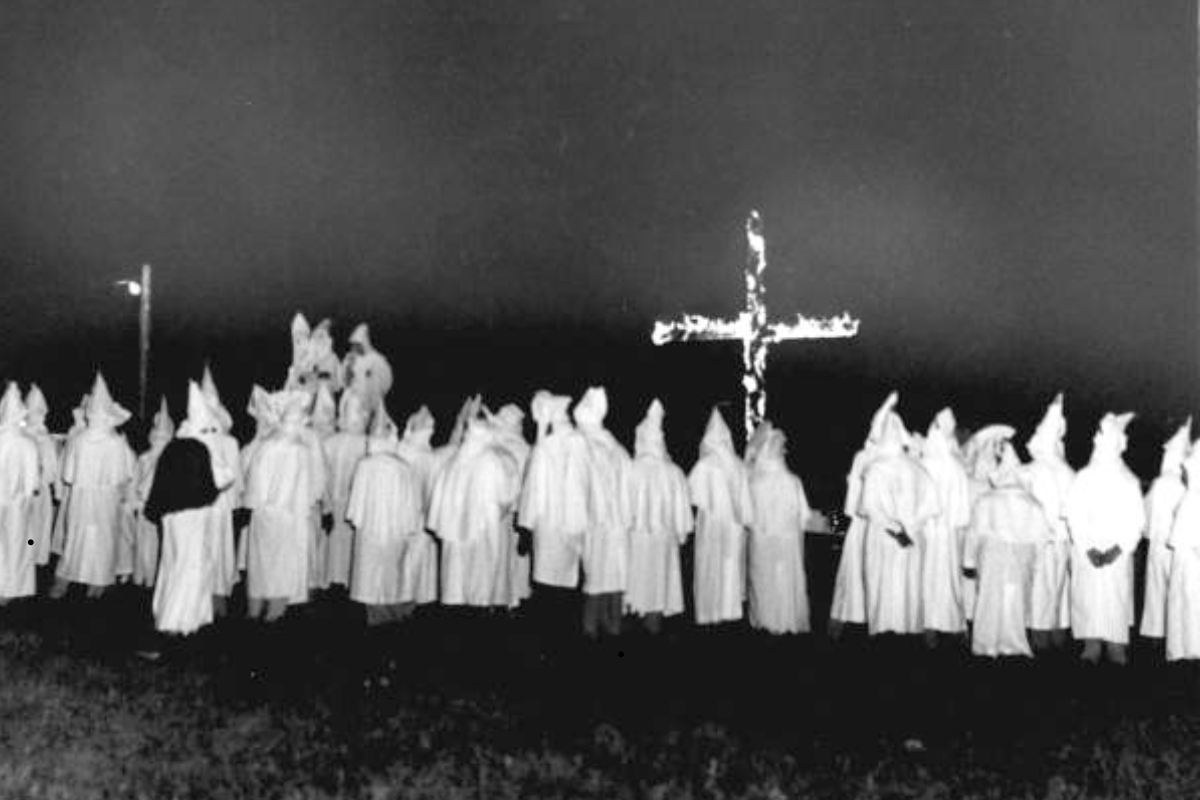
Ku Klux Klan rally
Courtesy of State Archives of Florida, Florida Memory
The Meaning and Application of Rights
The development of the Supreme Court’s free-speech case law did not begin until the twentieth century. Early twentieth-century free-speech cases involved federal sedition laws related to Congress’s efforts to prevent anarchy, communism, terrorism, and opposition to government policies like war and the military draft. Once the First Amendment freedom of speech and press were incorporated to the states in Gitlow v. New York (1925), the Court heard cases in a wider purview of legal controversaries.
Two things should be kept in mind regarding the Court’s free-speech case law. First and foremost, the First Amendment is vague. It reads “Congress shall make no law…abridging the freedom of speech, or of the press, or the right of the people peaceably to assemble, and to petition the Government for a redress of grievances.”
In Federalist 84, Alexander Hamilton explained why a bill of rights was excluded from the Constitution. He did not reject the idea of rights per se, but he questioned the prudence of adding vague, abstract rights to the document. Such statements of rights may be fitting “in a treatise of ethics” but not in “a constitution of government.” Hamilton used the freedom of the press to illustrate his point. He asked: “What is the liberty of the press? Who can give it any definition which would not leave the utmost latitude for evasion?” The Supreme Court’s free-speech case law illustrates Hamilton’s point. For free speech to have constitutional meaning, someone has to imbue it with definitional specificity that goes well beyond a mere declaration of the right.
For example, it is reasonable to assume that rights, including freedom of speech, are inseparable from the duty of individuals to exercise them responsibly and the duty of governments to address the needs of order. If this assumption is accepted, then rights are not absolute; they have limits. Courts, therefore, must find a balance between rights and liberty, on the one hand, and responsibility and order, on the other hand. The balancing of rights and duties, however, is complex because both rights and duties are dependent on circumstances that cannot be known at the time when rights are codified into a constitution. If rights are not fixed, reified abstractions, but dynamic, living, and flexible, then courts are an integral part of the ebb and flow of rights, the expansion and contraction of rights in accordance with the circumstances in which they are exercised. Given the relationship between rights and duties, it is not surprising that the Supreme Court’s free-speech case law has been variegated.
While the Supreme Court’s case law changed over time, its movements were governed by what can be considered the gravitational pull of the balance between liberty and order. Few Justices treat free-speech cases outside the ordered liberty paradigm, yet an increasing number of Justices in the middle of the twentieth century viewed that paradigm through the prism of abstract, disembodied rights. Hamilton suggested that bills of rights can be dangerous because they indicate that government power is unlimited and a bill of rights is necessary to identify the exceptions. He did not foresee the opposite problem, that rights would be perceived as absolute and, thus, hamper government’s ability to check and restrain irresponsible behavior that endangers the security of others or the nation.
John Stuart Mill’s Influence on Free-Speech Case Law
There is a second and related influence on Supreme Court free-speech case law that is neither legal in nature nor American in origin. John Stuart Mill’s utilitarian political theory has knowingly or unknowingly influenced the way most twentieth-century Supreme Court Justices think about free speech, rights generally, and the obligations of individuals to exercise rights responsibly. Mill argued that human beings have the right to do just about anything as long as it does not immediately and directly harm others. This so call harm principle is in one way or another a significant factor in how Justices decide free-speech cases. In short, the Justices tend to follow the cliché, no harm, no foul that stems from Mill’s theory. In other words, speech is protected if it does not cross the line that separates expression from harmful action. Mill’s harm principle has been influential especially in the domain of ideas. According to Mill, ideas can be wrong, but they do not do harm, and therefore should be exercised, in most every instance, without government limitation. There is, of course, room for disagreement between individuals who accept Mill’s theory. Justices disagree about the likely result of speech that may inspire violence, harm, or disorder.
A New and Expansive Free-Speech Standard
In the evolution of the Supreme Court’s free-speech case law leading up to Brandenburg v. Ohio (1969), it is clear that over time the Court was less willing to validate the constitutionality of government restrictions on free speech and more willing to push the boundaries of free-speech rights in the direction of absolute liberty. The balance between these competing forces tipped toward liberty and away from order during the Warren Court, creating momentum for the Court’s ruling in Brandenburg v. Ohio.
Background and Legal Issues in Brandenburg v. Ohio
Clarence Brandenburg was the leader of a Ku Klux Klan origination in Cincinnati, Ohio. He held a KKK meeting on a private farm in Hamilton County outside of Cincinnati and invited a local television reporter to film and broadcast the event. The reporter’s story was broadcast both locally and nationally. It showed Brandenburg dressed in KKK garb surrounded by other men, some of whom were carrying guns and wearing Klan hoods. A cross burned as Brandenburg uttered hateful words about racial and religious minorities and suggested that government suppression of the white race might require “revengenance.”
Brandenburg was arrested, tried, convicted, fined $1,000, and sentenced to 1-10 years in prison for violating an Ohio criminal syndicalism law that prohibited advocacy of “crime, sabotage, violence or unlawful methods of terrorism as a means of accomplishing industrial or political reform.” The law also prohibited individuals from assembling for the purpose “to teach or advocate the doctrine of criminal syndicalism.” Brandenburg lost two appeals in Ohio before the case was appealed to the U.S. Supreme Court where he was represented by the ACLU.
The Court’s Ruling in Brandenburg v. Ohio
The Court ruled 8-0 for Brandenburg and delivered its opinion per curiam because Justice Fortas was assigned the opinion by Chief Justice Warren, but Fortas resigned from the Court in May 1969 about one month before Brandenburg v. Ohio was announced. His resignation was the consequence of opposition to President LBJ’s nomination of Fortas to replace Chief Justice Warren after Warren announced his plan to retire at the conclusion of the Court’s term. Revelations about Fortas’s questionable financial behavior and contact with the president while serving on the Court led him to withdraw his name for consideration as chief justice and to his resignation from the Court under threat of impeachment.
The Court acknowledged that Brandenburg’s speech was hateful and advocated the use of violence, but it reaffirmed its ruling in Noto v. U.S. (1961) that merely advocating violence without preparation to perform violence was constitutionally protected speech. In making this distinction, the Court created what became known as the Brandenburg or incitement test and it overturned Whitney v. California (1927). That case created the bad tendency test which allowed government to punish mere advocacy of violence and restrict speech that had a tendency to cause harm.
In Brandenburg, the Court moved away as well from Justice Oliver Wendell Holmes’s clear and present danger test created in Schenck v. U.S. (1919). That standard determined whether the words in question “are used in such circumstances and are of such a nature as to create a clear and present danger that they will bring about the substantive evils that Congress has a right to prevent.” In rejecting the bad tendency test and moving away from the clear and present danger test that was already neutered by the Court in Dennis v. United States (1951), the Court also rejected the notion that deciding free-speech cases was a matter of balancing individual rights and state interests. Instead, the Court protected speech that advocated hatred and violence if it did not cross the line that separates expression from violent action. It did, however, leave open the possibility of exceptions to the general rule.
Brandenburg v. Ohio Legacy and Analysis
Brandenburg v. Ohio came at the end of the Warren Court. The Chief Justice retired from the Court two weeks after the case was handed down. Like many landmark cases, future courts chipped away at the edges of Brandenburg, but it remains a controlling precedent. In Communist Party of Indiana v. Whitcomb (1974), the Court ruled 9-0 that an Indiana law was unconstitutional that required candidates for public office to file an affidavit swearing that they did not “advocate the overthrow of local, state or national government by force or violence.” Some wondered how individuals who refused to take such an oath could also be sworn into office by taking an oath to support and defend the very constitution they were determined to destroy. In Virginia v. Black (2003), the Court distinguished between cross burning intended to intimidate and cross burning that merely expresses a political view. The former can be prohibited by government, the latter cannot. In Holder v. Humanitarian Law Project (2010) the Court ruled that government may restrict the speech related to the support of terrorist organizations. In Counterman v. Colorado (2023), the Court expanded free-speech protection to individuals who may not understand the consequences of their advocacy of violence and who engage in stalking.
The evolution of the Supreme Court’s free-speech case law is indicated by its increasing willingness to replace the discretion of governing officials and judges for abstract conceptions of rights. While the Court continued to take the circumstances of particular cases into account when deciding them, it increasingly interpreted those circumstances through the prism of disembodied rights.
Prudence is the paramount political virtue. When applied to the limits of free-speech rights, prudence requires careful consideration of what serves the common good in each case. Conceiving of free-speech as a near-absolute right, replaces prudence with a priori reasoning. Consider Justice Douglas’s concurring opinion in Brandenburg as an illustration. In it, he writes, “The line between what is permissible and not subject to control and what may be made impermissible and subject to regulation is the line between ideas and overt acts.” While the Court’s case law has not moved all the way to Justice Douglas’s position, it has moved close to it. Why, one may inquire, should ideas always be protected from government action? How could one possibly know what was prudent regarding the limits of free speech unless one was aware of the circumstances in which they were being exercised? Moreover, why is it necessarily best for a centralized court to determine the boundaries of civil liberties and not the communities in which those rights are exercised? “Circumstances,” Edmund Burke wrote, “give in reality to every political principle its distinguishing color and discriminating effect. The circumstances are what render every civil and political scheme beneficial or noxious to mankind.” Contrary to Burke’s point about circumstances, Justice Douglas aimed to make judicial decisions about the limits of free speech axiomatic. If speech is a mere expression of ideas, then it is constitutional.
In Justice Brennan’s majority opinion in Texas v. Johnson (1989), he included a form of action, flag burning, as speech and placed it into a category that recognized that speech and conduct can be indistinguishable. In such cases, he argued, the standard is not Justice Douglas’s stark line that separates expression from conduct, but another arguably less abstract line, that which separates violence from nonviolence. Both Justices Douglas and Brennan, however, miss the Burkean point about circumstances. If Burke is correct, then abstractly derived boundaries of civil liberties are unlikely to promote the common good. Hateful speech like that expressed by Brandeburg in the circumstances of a KKK meeting with a cross burning in the background and, hooded and armed Klansmen present can be construed as an act intended to terrorize. What else could it be? That violence was not the immediate consequence of Brandenburg’s speech matters less than its clear degradation of human dignity. Such weighing of costs and benefits is circumvented by the abstracting of rights.

Professor of Political Science at Middle Tennessee State University
Related Essays