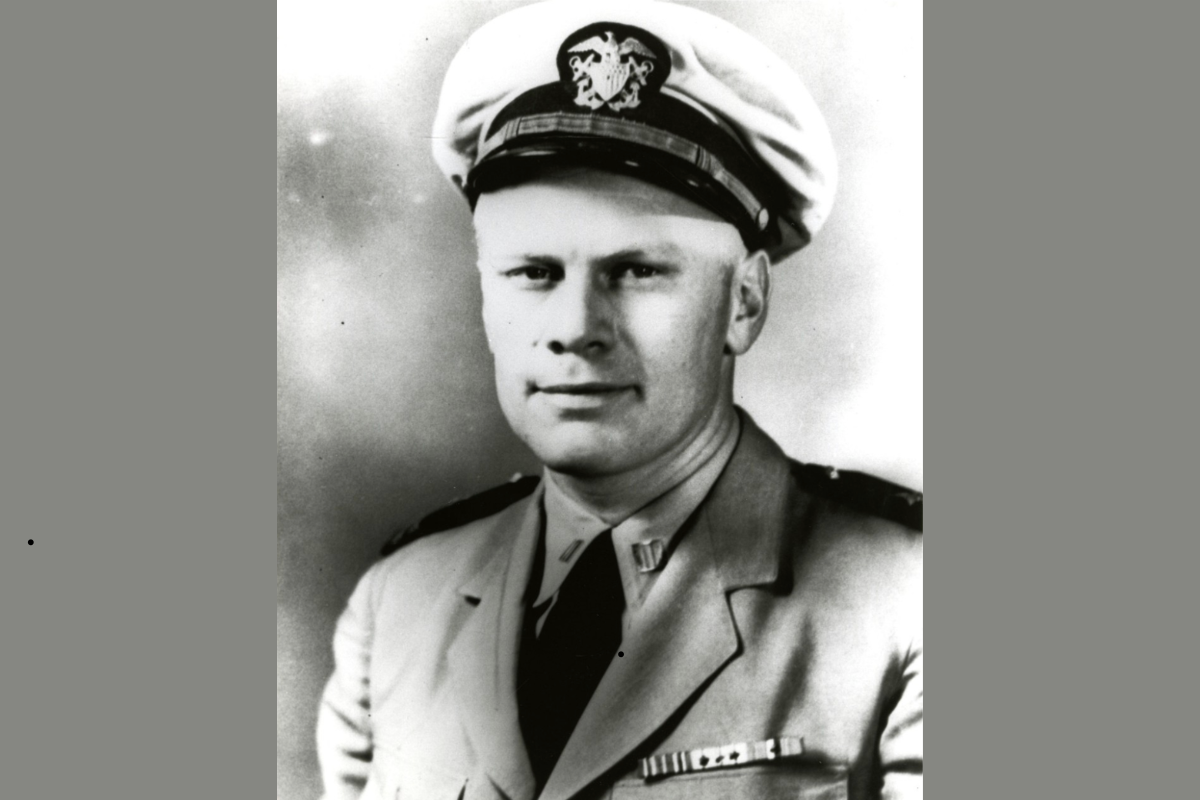
Shared Republics: Gerald R. Ford, Austin Blair, and the Traditions of Union, Liberty, and Civic Faith
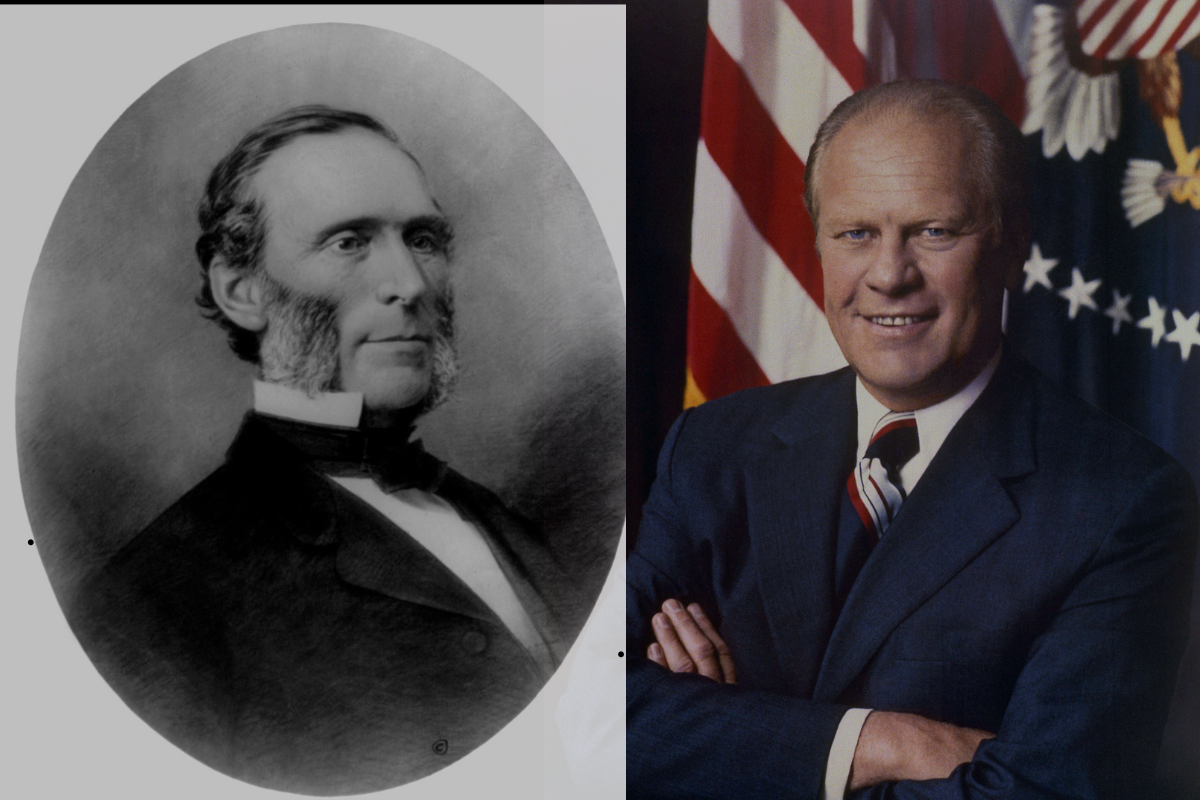
Michiganders Gerald R. Ford and Austin Blair are best understood through a shared civic tradition rather than through family (Blair married a Ford), political, collegiate, or professional ties. Their most significant relationship lies in a broad civic tradition: the development, preservation, and remembrance of a Michigan Republican legacy built on Union, constitutionalism, promotion of human rights, and national healing.
Blair, Michigan’s Civil War governor, belonged to the founding generation of that tradition. More than a century later, Ford inherited it as Grand Rapids congressman, House Minority Leader, and thirty-eighth President of the United States. Blair’s career helps explain the moral and constitutional roots of Michigan Republicanism in the nineteenth century. Ford’s public life shows how that same tradition could be applied to the challenges of Vietnam, Watergate, and the Bicentennial. Both men looked to the founding documents not as old relics, but as living sources of public trust during difficult moments in the nation’s history.
Long remembered as Michigan’s “War Governor,” as witnessed by his monument at center stage before the State Capitol in Lansing, Austin Blair served as the state’s thirteenth governor from 1861 to 1865. His public life began well before the Civil War and reflected the political changes that led to the creation of the Republican Party. Blair had been a Whig and a Free-Soil supporter. He was present when the Republican Party was organized in his hometown of Jackson, Michigan, on July 6, 1854, and he served on the platform committee. His political views were shaped by vehement opposition to the Kansas-Nebraska Act and by an unalterable conviction that the spread of slavery threatened the moral basis of self-government in America.
As governor during the Civil War, Blair quickly emerged as one of the country’s strongest supporters of the Union. He raised, equipped, supplied, and encouraged Michigan regiments while defending the war as both a constitutional duty and a moral cause. His opposition to slavery was not separate from his support for the Union. To Blair, the Union was worth saving because it embodied, though imperfectly, the promise of liberty established by the Declaration of Independence and popular self-government protected by the U.S. Constitution.
Blair’s long public career also shows that he was more than wartime governor. As a lawmaker, lawyer, governor, later member of Congress, and University of Michigan regent, he consistently linked politics with human dignity, civil rights, and legal reform. His support for ending capital punishment in Michigan, for ratifying the proposed Fifteenth Amendment, and for expanding suffrage to Black men and to women shows that his reform commitments extended beyond the immediate issues of the war.
Gerald R. Ford did not often mention Austin Blair during his congressional career or in presidential rhetoric. The absence is important. Ford usually focused on duty to institutions, the constitutional process, practical moderation, and national healing rather than on individual founders from Michigan’s past. Still, Ford intersected with Blair’s public memory in at least one clear and documented way.
On November 4, 1969, while serving as Minority Leader of the U.S. House of Representatives, Ford spoke at a Republican dinner in Big Rapids, Michigan. The Ford Presidential Library preserves the materials in a folder titled “Republican Dinner, Big Rapids, MI, November 4, 1969.” The surviving excerpts focus mostly on national politics and the Vietnam debate, not on Blair.[1] Even so, the setting is important: Ford was speaking to a Michigan Republican audience gathered under the symbolic name of Austin Blair.
That moment should not be exaggerated. It does not prove that Ford saw Blair as a personal model or that Blair played a major role in Ford’s thinking. It does show, however, that Blair’s name still had meaning within the Michigan Republican Party, in which Ford served as a major figure. In that way, Ford’s appearance at the Big Rapids dinner was part of a longer chain of remembrance, where the antislavery Republicanism of the nineteenth century continued to provide language, symbols, and credibility for later party leaders.
A secondary connection between the two men runs through the University of Michigan. Blair served as regent from 1881-1889, first as an appointee, then through statewide election. Ford attended U of M from 1931-1935, graduating with a Bachelor of Arts degree after a concentrated study of economics and political science. Ford went on to obtain a law degree from Yale University in 1941. Blair did not attend law school but achieved his ability to practice a century earlier, in 1841, by reading the law.
That they shared a connection via the Ford name needs clarification. Blair married Sarah L. Ford of Seneca County, New York, in 1849. Ford was born Leslie Lynch King Jr. in Nebraska and later took the name of his adoptive father, Gerald Rudolff Ford Sr., in Grand Rapids. No known family connection links Sarah L. Ford to President Ford, so the matching name should be treated as a coincidence unless separate genealogical evidence proves otherwise.
These biographical overlaps are useful, but they are secondary. The stronger connection between Blair and Ford is civic. Blair and Ford belong to different moments in the same Michigan-centered political tradition: Blair as a founder and Civil War exponent of Republican principles; Ford as a twentieth-century guardian of constitutional order and public trust.
Perhaps the best comparison between Blair and Ford lies in how each responded to a divided nation. Blair governed during secession and civil war. Ford led after the crises of Vietnam and Watergate. The settings were not identical, but each needed to adopt a public posture that combined moral judgment, respect for the Constitution, and a path back toward national unity.
Ford’s clemency program for Vietnam-era draft evaders and military deserters used the language of reconciliation associated with Abraham Lincoln, the first Republican president. In doing so, Ford placed a modern policy debate within a longer American tradition of mercy after conflict. Blair’s own postwar statements show a nuanced approach to reconstruction and reconciliation after the Confederacy of Southern states fell in 1865. Two recent publications of the Michigan Civil War Association examine Blair’s life and career in detail, relying mainly on his speeches and letters. They show how a determined opponent of secession became a spokesperson for restoring the eleven break-away states and their people into a Union based on respect and rights.[2]
Blair and Ford also shared a practice of grounding political arguments in America’s founding documents. For Blair, the Declaration of Independence and the Constitution gave both the moral and legal basis for opposing slavery and secession. His antislavery politics rested on the belief that a republic could not stay true to itself while allowing human bondage to keep spreading. His support for extending the franchise marked him as a leading proponent of fulfilling the Declaration’s claim that all humanity is endowed with certain inalienable rights
Ford made the founding documents central to his Bicentennial speeches. At the National Archives on July 2, 1976, he called the Declaration “the Polaris of our political order — the fixed star of freedom,” an immutable point “because it states moral truths that are eternal.” He regarded the Constitution as the instrument that allowed those lasting principles to be expanded and protected.[3] At Independence Hall two days later, Ford again connected founding documents to the strength of American self-government by signing the Bicentennial Day Declaration, “which reaffirmed a commitment to the principles of liberty, justice, and freedom that were first laid out in the Declaration of Independence.”[4]
The comparison is instructive. Blair invoked the founding documents to condemn slavery and defend the Union. Ford invoked them to rebuild public confidence in government after Watergate and Vietnam. In both cases, the founding served not as nostalgia but as a demanding standard against which present conduct could be measured.
The connection between Gerald Ford and Austin Blair is less than obvious, but it is also historically meaningful. Each represented a Michigan Republican response to national division: Blair through the Union, emancipation, and wartime leadership; Ford through constitutional stability, clemency, and Bicentennial reflection.
Read together, they show that political traditions are passed down in more ways than family lines or direct quotations. They are also preserved through institutions, commemorations, speeches, party gatherings, and public memory. Blair’s legacy gave Michigan Republicanism a Civil War-era language of liberty and Union. Ford’s career shows how that same language could be reshaped in the twentieth century into a language of constitutional steadiness and national repair.
As the United States commemorates its semiquincentennial, the Blair-Ford comparison offers more than a local history lesson. It encourages us to look again at how Americans have relied on the Declaration of Independence and the Constitution (as amended) during times of division, uncertainty, and reform. That is the value of the comparison: it shows how two leaders, originating from the same Midwest state, separated by a century, drew from the same civic inheritance to answer different crises in the ongoing work of the republic.
In an era marked by discord and disunity, the Blair-Ford legacy reminds Americans that constitutional faith, civic memory, and national repair have long been part of the republic’s unfinished work.
###
[1] Appreciation to Lauren White, CA, Archivist, Gerald R. Ford Presidential Library, for providing linkage to this resource: “Excerpts from a speech by Rep. Gerald R. Ford, R-Mich., Minority Leader, U.S. House of Representatives, at a Republican Dinner Tuesday evening, November 4, 1969 at Big Rapids, Mich.”
[2] Radical of Radicals: Austin Blair, Civil War Governor—In His Own Words (Mission Point Press, 2025); More Than Monument: Austin Blair, Ex-Governor—In His Own Words (Mission Point Press, 2026).
[3] https://www.fordlibrarymuseum.gov/sites/default/files/pdf_documents/library/document/0122/1252949.pdf
[4] https://www.fordlibrarymuseum.gov/digital-research-room/topic-guides/american-bicentennial-celebration#event-number-1498