Texas v. Johnson (1989)
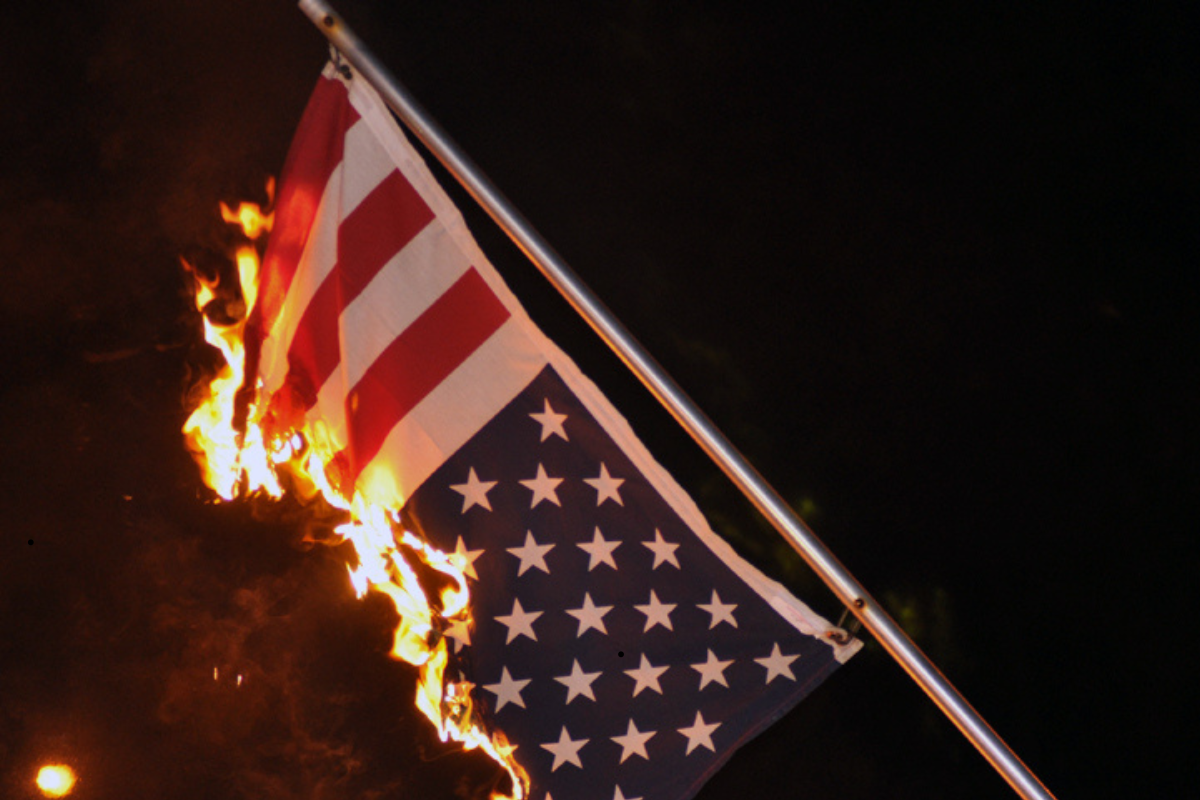
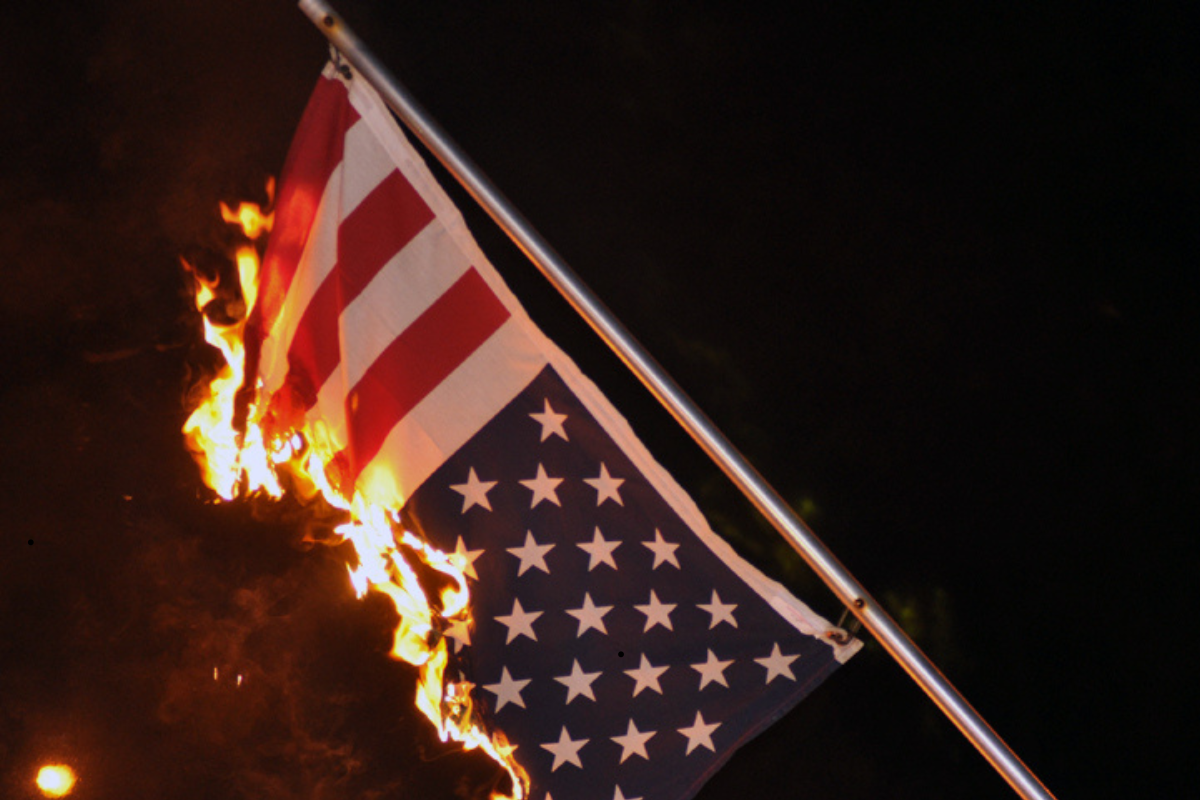
Protestors burn the American flag during the Ferguson unrest, 2014. Photo courtesy Loavesofbread on wikimedia.org.
According to the wisdom of Finley Peter Dunne’s fictional Irish bartender, Mr. Dooley, “the’ supreme court follows the iliction returns.” Dunne may have been a humorist, but Dooley’s take on the Court is regarded as something of a truism, in that it is rare for the Supreme Court to move too far beyond the guardrails of public sentiment on issues that come before it. Nevertheless, a small number of Supreme Court opinions have so run against the grain as to trigger popular outrage and concerted political action. The Court’s flag-burning opinion in Texas v. Johnson (1989) was one such case.
The Historical Context: Flag Burning as Political Protest
The protest era of the Vietnam War spurred numerous constitutional debates, including those around whether and to what extent the speech protections of the First Amendment extended to non-verbal symbolic behavior. In U.S. v. O’Brien (1968) the Court upheld the conviction under the Selective Service Act of David O’Brien’s burning of his draft card in objection to the war. The proscription against destroying one’s draft card was deemed, not as a suppression of O’Brien’s message, but rather a non-speech related regulation designed to ensure the government could effectively manage a draft as part of its constitutionally enumerated power to raise a standing army. In contrast, the Court in Tinker v. Des Moines (1969) found the expressive behavior of public school students wearing anti-Vietnam war arm bands in silent protest to be protected First Amendment speech. Two years later, the Court overturned Paul Cohen’s conviction for roaming the halls of a Los Angeles courthouse while wearing a jacket on which he had written “F*** the Draft.” (Cohen v. California, 1971) Whatever the impact on those offended by the message, Cohen’s coat was deemed protected speech that fell short of unprotected "fighting words" or obscenity.
The anti-war movement also sparked a sharp increase in acts of burning or destruction of the American flag. Prominent demonstrations in New York’s Central Park and elsewhere across the country generated intense controversy and a hostile public response. The backlash was sufficiently acute to prompt Congress to pass the Federal Flag Desecration Law of 1968, which made it a crime to burn, trample upon, or otherwise mutilate the U.S. flag. Flag protection laws went as far back as the Civil War, and proliferated in the early Twentieth Century. Additional states passed strong anti-flag desecration laws modeled after the federal 1968 statute, and by the 1980s, forty-eight of the fifty states had flag desecration laws on the books.
It was inevitable, then, that the constitutional status of expressive conduct in the form of flag burning would reach the Supreme Court. Flags in other contexts had been recognized by the Court as early as 1931 as having special standing as vehicles for expression or symbolic speech. Shortly after passage of the federal law in 1968, the Court turned its attention to the free-speech boundaries around acts of public destruction of the American flag. The issue proved a bedeviling one for the Court. Over two decades, it issued a handful of decisions which favored those charged with mutilating or mistreating the flag. But those opinions were narrowly drawn, avoiding the fundamental question of whether flag desecration was deserving of First Amendment protection.
Gregory Johnson’s Flag Burning Protest
Protests around the Republican national convention in Dallas in the summer of 1984 finally provided the Court with the vehicle by which to rule definitely on the issue. A group of about a hundred Communist Youth Brigade members marched through the streets of the city, chanting slogans and spray-painting corporate office buildings. At one point, one of them grabbed a flag from a Mercantile Bank building and handed it to Gregory Lee Johnson, one of the group’s leaders. Once the march had reached the convention hall, and with law enforcement looking on, Johnson doused the flag in kerosene and lit it on fire, while the protesters chanted “America, the red, white, and blue, we spit on you.” Johnson was promptly arrested, charged and eventually convicted of violating a Texas law that prohibited desecration of the flag with the knowledge that it would seriously offend one observing it. Johnson was sentenced to a year in prison and assessed a $2000 fine. A state court of appeals affirmed the conviction, but it was overturned by the Texas Court of Criminal Appeals. The U.S. Supreme Court accepted the state’s appeal.
On June 21, 1989, the Court rendered its decision in Texas v. Johnson. The 5-4 outcome in Johnson’s favor featured an unusual alignment of justices. Liberal stalwarts Brennan, Marshall and Blackmun were joined by Justices Scalia and Kennedy in the majority, while Justices Rehnquist, White, Stevens and O’Connor dissented.
Brennan’s Majority Opinion
Justice William Brennan wrote for the majority. His opinion first dealt with the question of whether the burning of the flag was “expressive conduct” deserving of First Amendment protection. Brennan noted that the Court had previously found that speech protections extend beyond the spoken or written word, to conduct “sufficiently imbued with elements of communication to fall within the scope of the First Amendment.” That required an “intent to convey a particularized message” that would likely be “understood by those who viewed it.” Brennan found that Johnson’s act of flag burning met that standard. It was the culmination of a political demonstration aimed at the Republican convention and the nomination of President Reagan, and thus was “sufficiently imbued” with elements of communication to qualify as expressive conduct.
Brennan then turned to the question of whether the government’s suppression of Johnson’s speech was aimed at the content of his expressive conduct. Recall from the O’Brien (draft card burning) case that the government could regulate or prohibit the non-speech elements of expressive behavior if it had a sufficiently compelling justification. In other words, the Texas statute had to rest upon an interest unrelated to the suppression of the message itself. Texas offered two justifications for the law. The first was to prevent likely breaches of the peace. Bennan quickly dismissed this contention, stressing a factual record devoid of any actual disturbances attributable to the burning of the flag. Johnson’s act did not qualify as a “fighting words” exception to free speech, since it was unlikely to “provoke the average person to retaliation.” Brennan rejected the notion that the state could ban expression of “disagreeable ideas on the unsupported assumption that their very disagreeableness will provoke violence.” Indeed Brennan considered a principal function of free speech to invite dispute. He mused that an act of protest might “indeed best serve its high purpose when it induces a condition of unrest, creates dissatisfaction . . . or even stirs people to anger.”
Second, Texas asserted an interest in preserving the flag as a symbol of nationhood and national unity. Brennan scoffed at the idea that a single gesture of flag burning could work any harm to the symbolic force of the flag. He flatly rejected the government’s claim that it was not prohibiting any words or message that criticized the flag, but was only protecting the symbol itself. Rather he definitively concluded that the Texas statute was aimed at banning the expressive idea communicated in the burning of the flag.
Texas’ focus on the precise nature of Johnson’s expression, moreover, misses the point . . . that the Government may not prohibit expression simply because it disagrees with its message, is not dependent on the particular mode in which one chooses to express an idea . . .
It was bedrock First Amendment principle that the government may not prohibit the expression of ideas simply because society finds them offensive. And Brennan found it undeniable that “Johnson’s political expression was restricted because of the content of the message he conveyed.”
The Rehnquist Dissent
The principal dissent, authored by Justice Rehnquist, was something of an ode to the flag. Rehnquist waxed poetic about the “[m]illions and millions of Americans [who] regard it with an almost mystical reverence regardless of what sort of social, political, or philosophical beliefs they may have.” Rehnquist found it well within the “high purposes of a democratic society” to legislate against conduct deemed evil or offensive to the majority of people, be it “murder embezzlement, pollution or flag burning.”
The dissent took issue with virtually every assumption underlying the majority opinion, chief among them the notion that Johnson’s act of flag burning even constituted some kind of message. Rehnquist argued that the flag was a unique and “visible symbol” of the nation that stood apart from any particular political viewpoint, party or philosophy. Hence the public burning of the flag “was no essential part of any exposition of ideas . . .” Rehnquist’s description was memorable; “Flag burning is the equivalent of an inarticulate grunt or roar that, it seems fair to say, is most likely to be indulged in not to express any particular idea, but to antagonize others.”
Rehnquist found the majority view that Johnson was convicted for the content of his message almost laughable. He narrated a litany of explicit messages that Johnson had conveyed during the protest, for which he had suffered no consequences. Moreover, Rehnquist interpreted the burning of the flag as conveying any message that could have been effectively conveyed “just as forcefully in a dozen different ways.”
The Texas statute deprived Johnson of only one rather inarticulate symbolic form of protest . . . and left him with a full panoply of other symbols and every conceivable form of verbal expression to express his deep disapproval of national policy. Thus in no way could it be said that Texas is punishing him because his hearers . . . were profoundly opposed to the message that he sought to convey.
It was only Johnson’s use of the particular symbol of the flag, and not any ideas he sought to convey by it or by his many other expressions for which he was punished.
The Impact of the Decision
Texas v. Johnson surely belongs on the short list of most unpopular decisions in the Court’s modern era, alongside the “religion in public schools” cases of the early 1960s and the Kelo takings case. The decision, which upended anti-desecration laws in forty-eight states and at the federal level, set off a firestorm of outrage. A national public opinion poll taken shortly after the ruling showed three-quarters of respondents disagreed with the decision, and nearly two-thirds supported a constitutional amendment to protect the flag. Other polls revealed a substantial cratering of public confidence in the Court. Congressional action in the short term mirrored the popular response. A House Resolution condemning the decision passed with nary a dissenting vote. A bipartisan resolution in the Senate likewise passed with only three “nay” votes. Multiple proposals were introduced in Congress to amend the constitution to void the decision.
As emotions gradually cooled over time, so too did the energy behind the movement for a constitutional amendment. The proposal ultimately considered by the Senate fell well short of the two-thirds needed for passage. Congress did, however, pass the Federal Flag Protection Act of 1989, which made it a federal crime to knowingly mutilate, deface, burn, or trample on a U.S. flag. The Act would meet the same fate as the Texas law, struck down by the same alignment of justices in the 1990 decision in U.S. v. Eichman.
Texas v. Johnson proved to be formative of future jurisprudence relating to expressive conduct. Key questions that separated the majority and dissent have persisted in disputes involving symbolic speech. One such question was the extent to which the conduct need convey some intelligible message or idea. Did the constitutionality of the expressive conduct hinge on the speaker’s intended message, or how a reasonable viewer might interpret it? Brennan did not seem to take seriously his own standard of a “particularized message” that could be understood by a reasonable observer of the conduct. The notable Morse v. Frederick case (2007) revealed a Court seemingly befuddled by the question. A narrowly divided Court upheld the suspension of four public school students who unfurling a fourteen-foot high banner that read "BONG HiTS 4 JESUS" at a school-sponsored Olympic torch relay event. Even though the boys admitted it was mere gibberish meant to get them attention, Chief Justice Roberts reached the dubious conclusion that the sign could be reasonably interpreted as promoting illegal drug use, and hence could be suppressed. Equally problematic was the willingness of the four dissenters to attribute constitutional status to a sign devoid of a meaningful message.
A second important question was whether the Court would ever take into account the impact of offensive conduct on the listener or observer. The Court’s decision in Snyder v. Phelps (2011) finding the deeply objectionable protests of the Westboro Baptist Church at military funerals to be protected speech suggested the answer was no. Yet in the context of pro-life protests outside abortion clinics, the Court was inclined to take into account the sensibilities of the unwanted listeners entering the clinic (Hill v. Colorado 2000).
The Texas v. Johnson majority came down on several other important questions that might not withstand scrutiny of the Court as it is currently comprised. One of those was the determination that a speaker could not be constrained or limited in the mode or manner by which they chose to speak. Another was the subjective determination of the majority that the Texas statute was necessarily aimed at the underlying message rather than the conduct itself. Future litigation may well focus on whether the mode of expression be regulated or limited, and if the method of expression and the message conveyed can be separated or differentiated.
A Postscript: The Ongoing Salience of Flag Burning
Flag burning persists as a common mode of protest. Cultural upheaval over various happenings have included the torching of the flag as a means of anti-government protest, including racial turmoil sparked by the Ferguson, Missouri unrest in 2014, the widespread protests after the George Floyd killing in 2020, and reactions to the Court’s Dobbs decision overturning Roe v. Wade. Meanwhile, a survey in 2023 showed six in ten respondents considered flag burning to be "always unacceptable."
Perhaps looking to capitalize on public sentiment, President Trump jumped into the flag-burning fray with an August 2025 executive order entitled Prosecuting Burning of the American Flag. While the order sought to place prosecution of flag burning within the framework of Texas v. Johnson, it also advocated that flag desecration that rises to the level of “fighting words” or is likely to incite violence can and should be subject to prosecution. The order also instructed the attorney general to examine existing laws on property damage, discrimination, hate crimes, and other forms of violence as a basis for pursuing flag burning that causes “harm unrelated to expression, consistent with the First Amendment.” The consensus among constitutional experts who have weighed is that the order is seriously flawed. But that likely will not deter an administration whose ultimate goal is to get flag burning back in front of a strongly conservative Court that just might be inclined to pare back, if not overturn, Texas v. Johnson.