Gerald R. Ford and Clayton Yeutter: Farmers' Friends
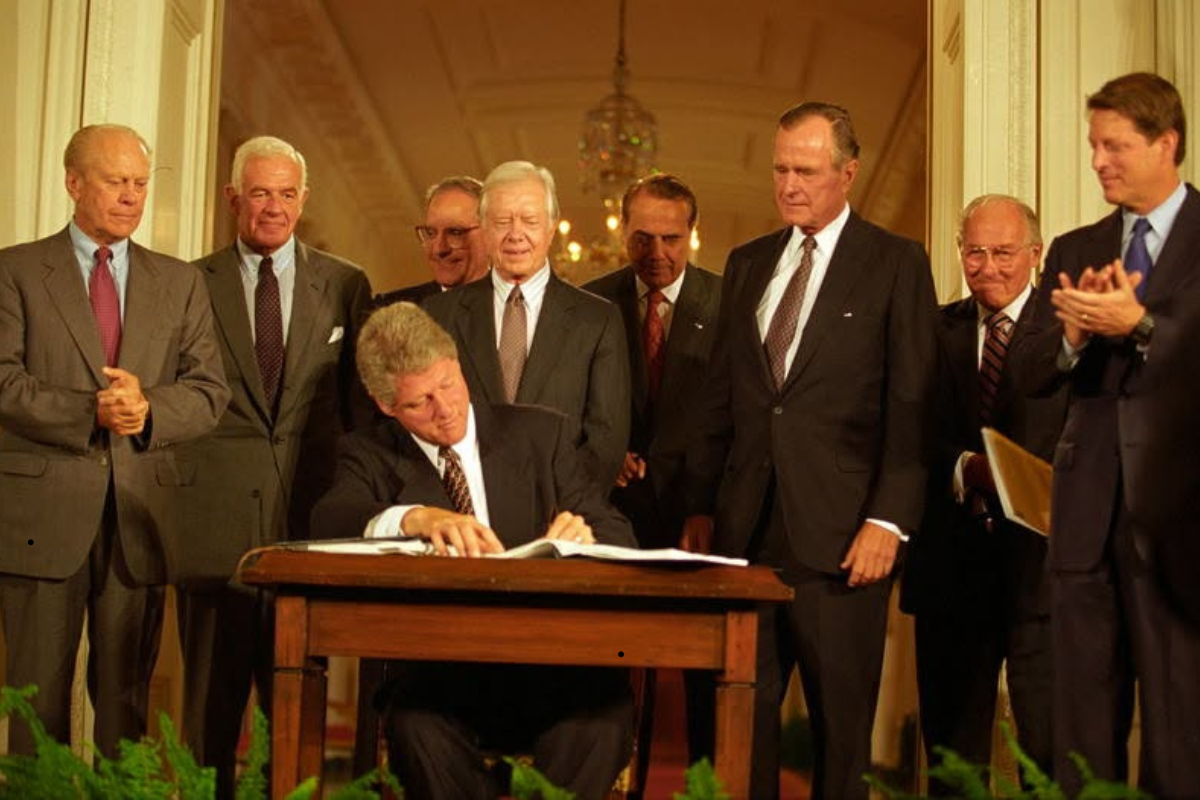
On September 14, 1993, President Bill Clinton signed supplemental agreements to the North American Free Trade Agreement (NAFTA) during a kick-off event in the East Room of the White House (pictured). He was joined by former Presidents Gerald Ford, Jimmy Carter, and George H.W. Bush.
Nebraskan Clayton Yeutter, an agricultural economist and lawyer in the Nixon and Ford administrations, had a major influence on domestic and international farm policy. His leadership kept U.S. farmers competitive during a period of economic challenges and international market disruptions caused by unfair trade farm policies. Yeutter enjoyed career advancement in the Ford White House. The two native-born Nebraskans worked well together.
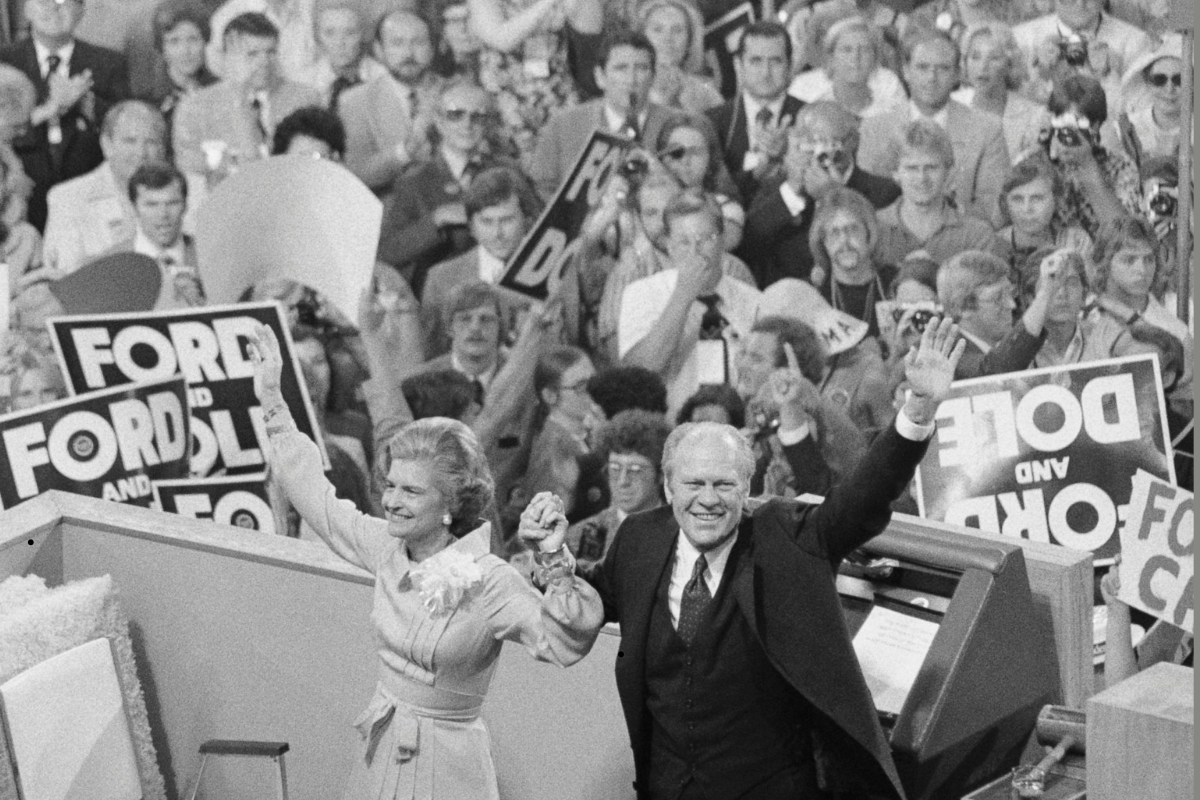
The GOP National political platforms from 1968 to 1976 sought expanded international trade in farm products to improve domestic incomes. The 1968 GOP Platform said, “The Republican Party is committed to the concept that a sound agricultural economy is imperative to the national interest.” This message reassured farmers that Republicans understood their important role in the U.S. economy. Republicans told farm country voters: “Prosperity, opportunity, abundance, and efficiency in agriculture benefit every American.”
To strengthen America’s farm economy and rural communities, Republicans pledged sound economic policies, better management of agricultural programs, greater emphasis on research for industrial uses of farm products, and improved farm income through expanded trade, among other approaches. On farm trade expansion, Republicans pledged: “A truly two-way export-import policy which protects American agriculture from unfair foreign competition while increasing our overseas commodity dollar sales to the rapidly expanding world population.”
In 1970, Yeutter, a former assistant to the Nebraska governor, joined the Nixon administration as head of the Consumer and Marketing Service at the U.S. Department of Agriculture. It was the beginning of a remarkably successful government career.
The 1972 GOP Platform hailed “A New Era of Diplomacy,” which cited the administration’s success in reducing trade barriers to American exports. Republicans reminded farmers they had “established negotiations to expand foreign market access” for their products. The GOP’s “new era of negotiations” had led to “an agreement for the Soviet purchase, over a three-year period, of a minimum of $750 million in United States grains —the largest long-term commercial trade purchase agreement ever made between two nations. This amounts to a 17-percent increase in grain exports by United States farmers. A U.S.-Soviet Commercial Commission has been established, and negotiations are now underway as both countries seek a general expansion of trade.” Clayton Yeutter, who called himself a moderate Republican, was on the Commission.
The 1976 GOP Platform called on Congress to support farm trade expansion. “We recognize the importance of the multilateral trade negotiations now in progress and urge our representatives [in Congress] to obtain the most beneficial agreements for our farmers and the nation's economy. Yeutter, as Deputy Special Trade Representative in the Executive Office of the President, worked on these multilateral negotiations.
In the 1985 Yearbook of Agriculture (YOA), titled “U.S. Agriculture in a Global Economy,” Yeutter contributed an excellent six-page article on “Trade Negotiations – Past and Present.” It is a historical summary of U.S. trade negotiations from the 1800s to the 1980s. Also in 1985, Ronald Reagan named Yeutter U.S. Trade Representative.
After World War II, the U.S. and its trading partners adopted the General Agreement on Tariffs and Trade (GATT). Negotiations were conducted to reduce or eliminate barriers to trade. Seven trade rounds sought to cut tariffs. The rounds excluded farm products. In 1984, GATT created a Committee on Trade in Agriculture. Its purpose was to liberalize farm trade.
In his 1985 YOA article, Yeutter explained why trade policies, including tariffs and export subsidies, differed for industrial goods and farm goods. He explained how export subsidies distorted prices, created oversupply in exporting nations, and penalized consumers and producers. Yeutter argued for ending these protectionist policies. In 1984, GATT created a Committee on Trade in Agriculture. Its purpose was to liberalize farm trade.
During the George H.W. Bush administration, Yeutter served as Secretary of Agriculture, where he supported the North American Free Trade Agreement (NAFTA). If Bush had been reelected, NAFTA might have been implemented more effectively to achieve better trade outcomes. At USDA, Yeutter successfully fought for freer and fairer trade for U.S. farmers.
In 1995, the World Trade Organization began operations. In 2001, the European Union agreed to phase out all export subsidies in the Doha Round of Trade Negotiations. In 2015, at the WTO’s Tenth Ministerial Conference, the EU ended export subsidies, including direct payments, export loans, and tax benefits, for agriculture. The EU agreed with Yeutter’s arguments from the 1980s that these policies distorted prices and undermined competitiveness in exporting and importing countries. Yeutter died in 2017.
“Clayton Yeutter played an indispensable role in American history when he helped negotiate the 1988 Canada-United States Free Trade Agreement. What followed was the more expansive 1994 North American Free Trade Agreement and a toppling of dominoes around the world as nation after nation lifted trade barriers,” according to James A. Baker III.
“It was Clayton Yeutter who leveled the playing field for American farmers and ranchers so they could sell their products worldwide,” said former Nebraska Governor and U.S. Senator Michael O. Johanns.
Joseph Weber’s 2021 book “Rhymes with Fighter: Clayton Yeutter American Statesman” is an excellent biography of the Ambassador. Former U.S. Trade Representative Carla Hills said the book “brilliantly captures the outstanding character, warm personality, and enormous talent of a man who has richly contributed to our nation and its values.”
Describing his family’s farm work, Yeutter once said: “You just don’t work any harder than we did. Daylight saving time would have been irrelevant in our family.” In the early 1960s, a Nebraska newspaper reported that Yeutter was “honest and frank.” In the 1970s, some newspapers reported the same about Gerald R. Ford. Today, historians use those words to describe both leaders.
“We’ve really got quite a state here,” Yeutter once said about Nebraska. “All we need is to believe in ourselves and begin to convince other people.” Clayton Yeutter was a Farm State American Statesman.

James Patterson is a former U.S. diplomat, life member of the American Foreign Service Association.
Related Essays